Before you read this I want you to take out your to-do list RIGHT NOW!
Come on… I know you have one.
If you are currently reading this blog post that you, like myself, are similar to so many other athletes, coaches, and entrepreneurs. You my friend, are a go getter!
You have so many things to do everyday that you can’t remember it all. You have to write it down and are constantly updating and checking your to-do list.
Am I right?
At times our to-do list can be exhausting and cause anxious thoughts, feelings, and emotions. Several times I stay up late trying to complete my to-do list which ends up having negative consequences. I lose sleep, can’t turn my mind off when I try to sleep, am tired the next day, and my stress levels increase. Why is it that we let this little sheet of paper control our lives?

I recently was working with a softball player and she was stressed to the max. Her issue wasn’t just her sport though. This is the case with many athletes. Yes, their sport induces stress at times but it’s adding in going to school, assignments, work, eating, sleeping, and finding “me” time that adds more stress. This certain athlete had tryouts coming up, which is stressful in itself, along with tons of assignments, tests, and wanting to participate in a march.
How in the world with all of this going on is she going to focus on being her best at tryouts?!
The answer? BREAK IT DOWN.
I had her write down everything she HAD to do that was causing her stress. We planned out each day for the next week specifically starting when she woke up to when she went to bed. We added in times to eat, ideas for what to eat so she didn’t waste time thinking about that when to fit in homework, prioritize homework, and adding in showering and some TV time.
This is exactly what I want you to do. Break it down into chunks. Now I want you to look at only ONE THING AT A TIME. Instead of looking at the whole list of items, which is overwhelming, ask yourself, “What do I need to do right now?”

That’s all I want you to worry about. One thing at a time. After our plan, my athlete only had to worry about going to bed after we met. In the morning her only concern was waking up, then getting food in her stomach, then packing up her softball equipment, then she can worry about tryouts. She was to not think about tryouts while eating or getting ready. She also was to not think about school and the upcoming assignments during any time except for the time she scheduled for it. After writing this out she felt much more relaxed and confident in knowing that she had a plan and the time to meet her demanding tasks.
If we can focus our minds on one task it will get done sooner and with less stress. Also, once you complete one of your tasks I want you to cross it off. Feel the success and satisfaction of completing an item on your list. No matter how little it may be take pride in that accomplishment.
If you can break your tasks up into chunks it will not seem as stressful and busy. This way you can also add in tasks that you might be holding back on starting because it seems too taxing. I experienced this often with my consulting company, The Mental Clutch. It seemed my to-do list was never-ending.
I wanted to design a website, start blogging and create an email list. These were huge and daunting tasks to me. It’s almost one year later and I have completed all three. Do not let time dictate your to-do list unless it has a deadline in reality. As long as it gets done, that’s all that matters.
One of the reasons I waited so long to blog and create my email list was because I wanted it to be perfect. I worried about what content to put into it, how readers will perceive it, and let my worst critic, my mind, get to me. Getting it done though is better than waiting for perfection.
I finally decided to break it into chunks and day by day I would add ideas for blogs, start writing, and just publish them, even when I thought they could be better. For my email list, I focused more on getting the email out there instead of spending so much time on adding just the right content. Getting it done is better than waiting for perfection. How come? Because perfection will never come! If I waited for that I still to this day will not have any blogs or an email list.
We, as a society, are so focused on the final product that we take longer to finish the stuff we are working on. Whether that’s writing a blog, posting something on social media, working on a project, creating a presentation, etc. JUST GET ER DONE!
What if we just buckled down and focused on getting it done instead of worrying about it being perfect. There may always be a typo, misspelled word, or other types of errors. There may always be something we could have done better or explained more clearly. But this is how we learn to make the NEXT presentation, blog, project, or post even better.
Instead of waiting for it to be perfect (which probably will never happen) just get it done so you can mark it off your to-do list and focus on the next thing.
I hope this post revved up your motivation to hit your to-do list, break it down, focus on one task at a time, and GET ER DONE!




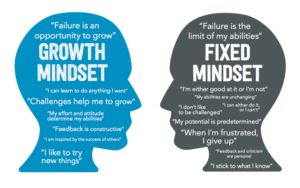 5 ways to develop a growth mindset:
1. Focus on effort.
If you are a coach, parent, or athlete praise the amount of effort that is being put in. If we can change our focus to effort instead of the outcome such as a grade on a test, how heavy you lifted, how fast you ran, or comparing yourself to how others do we can fuel ourselves from our IMPROVEMENTS. Remember, “hard work beats talent when talent doesn’t work hard.” Trust that if you consistently put in your best effort the end results will come. Change your mentality from, “I’m not strong because I only lifted this much..” to, “I warmed up properly and gave my best effort on that set. With continued practice I will be able to lift more over time.”
2.Become process-focused.
Focus on the process over the outcome. One way to do this is by creating goals that are process-focused rather than outcome-focused. Once you’ve identified your outcome goal you need to create and focus on process goals that will direct you to where you want to go. Once you are able to meet the process goals the outcome goal will be met naturally at times. It is like going on a road trip. We might know WHERE we want to go but we have to figure out and focus on the turns we need to make to GET there. Keep your focus on the process over the outcome/destination.
3. View setbacks as comebacks.
Keep persisting and overcome challenges. Understand and accept that the world of sport is going to bring along obstacles and setbacks. It might be an injury, a losing record, a slow start to the season, or being out of shape. Instead of focusing on the negatives and giving up, buckle down and keep working at it. Continue to give the best effort you can and remind yourself that whatever setback you are experiencing is a chance to make a major comeback. Use the setbacks as motivation and become more determined to keep moving forward.
4.Fail forward
Learn from your mistakes and failures. Understand that the only way we can learn to achieve success and meet our goals is to experience failure. Use failures as teaching moments and take away something from that experience that you can apply in the future. Each time you fail, you are one step closer to achieving. In every game or performance there will always be a winner and a loser, and we need to understand that we can’t win all the time. We have to learn how to lose, how to learn from it, and how to keep pushing to be better and stronger next time.
5.Be open to feedback
Make sure that you are asking for feedback from your coaches and teammates. Understand that whatever feedback they give you is for your BENEFIT and it is not to upset you or make you feel less than. Those with a fixed mindset have a difficult time receiving feedback and become frustrated compared to those with a growth mindset who strive for constant improvement. People with a growth mindset understand that there is no such thing as “perfection” and that there’s always room for improvement. They seek out ways to improve by asking others for their opinions, advice, and feedback to increase their abilities. Trust the people around you and take the time to listen and apply what they are telling you.
Put it into practice!
One great way to develop a growth mindset is to seek out new challenges and try new things that you are not naturally good at. This way you will be more likely to experience setbacks and failures and practice the skills necessary to develop a growth mindset. Use this experience towards skills and abilities you have not yet developed and enjoy the improvements, not matter how small. Trust the process and know that with continued effort you CAN and WILL develop the skills and abilities you are working towards.
Want to learn more about Carol Dweck and her work on mindset? Click to watch her
5 ways to develop a growth mindset:
1. Focus on effort.
If you are a coach, parent, or athlete praise the amount of effort that is being put in. If we can change our focus to effort instead of the outcome such as a grade on a test, how heavy you lifted, how fast you ran, or comparing yourself to how others do we can fuel ourselves from our IMPROVEMENTS. Remember, “hard work beats talent when talent doesn’t work hard.” Trust that if you consistently put in your best effort the end results will come. Change your mentality from, “I’m not strong because I only lifted this much..” to, “I warmed up properly and gave my best effort on that set. With continued practice I will be able to lift more over time.”
2.Become process-focused.
Focus on the process over the outcome. One way to do this is by creating goals that are process-focused rather than outcome-focused. Once you’ve identified your outcome goal you need to create and focus on process goals that will direct you to where you want to go. Once you are able to meet the process goals the outcome goal will be met naturally at times. It is like going on a road trip. We might know WHERE we want to go but we have to figure out and focus on the turns we need to make to GET there. Keep your focus on the process over the outcome/destination.
3. View setbacks as comebacks.
Keep persisting and overcome challenges. Understand and accept that the world of sport is going to bring along obstacles and setbacks. It might be an injury, a losing record, a slow start to the season, or being out of shape. Instead of focusing on the negatives and giving up, buckle down and keep working at it. Continue to give the best effort you can and remind yourself that whatever setback you are experiencing is a chance to make a major comeback. Use the setbacks as motivation and become more determined to keep moving forward.
4.Fail forward
Learn from your mistakes and failures. Understand that the only way we can learn to achieve success and meet our goals is to experience failure. Use failures as teaching moments and take away something from that experience that you can apply in the future. Each time you fail, you are one step closer to achieving. In every game or performance there will always be a winner and a loser, and we need to understand that we can’t win all the time. We have to learn how to lose, how to learn from it, and how to keep pushing to be better and stronger next time.
5.Be open to feedback
Make sure that you are asking for feedback from your coaches and teammates. Understand that whatever feedback they give you is for your BENEFIT and it is not to upset you or make you feel less than. Those with a fixed mindset have a difficult time receiving feedback and become frustrated compared to those with a growth mindset who strive for constant improvement. People with a growth mindset understand that there is no such thing as “perfection” and that there’s always room for improvement. They seek out ways to improve by asking others for their opinions, advice, and feedback to increase their abilities. Trust the people around you and take the time to listen and apply what they are telling you.
Put it into practice!
One great way to develop a growth mindset is to seek out new challenges and try new things that you are not naturally good at. This way you will be more likely to experience setbacks and failures and practice the skills necessary to develop a growth mindset. Use this experience towards skills and abilities you have not yet developed and enjoy the improvements, not matter how small. Trust the process and know that with continued effort you CAN and WILL develop the skills and abilities you are working towards.
Want to learn more about Carol Dweck and her work on mindset? Click to watch her